


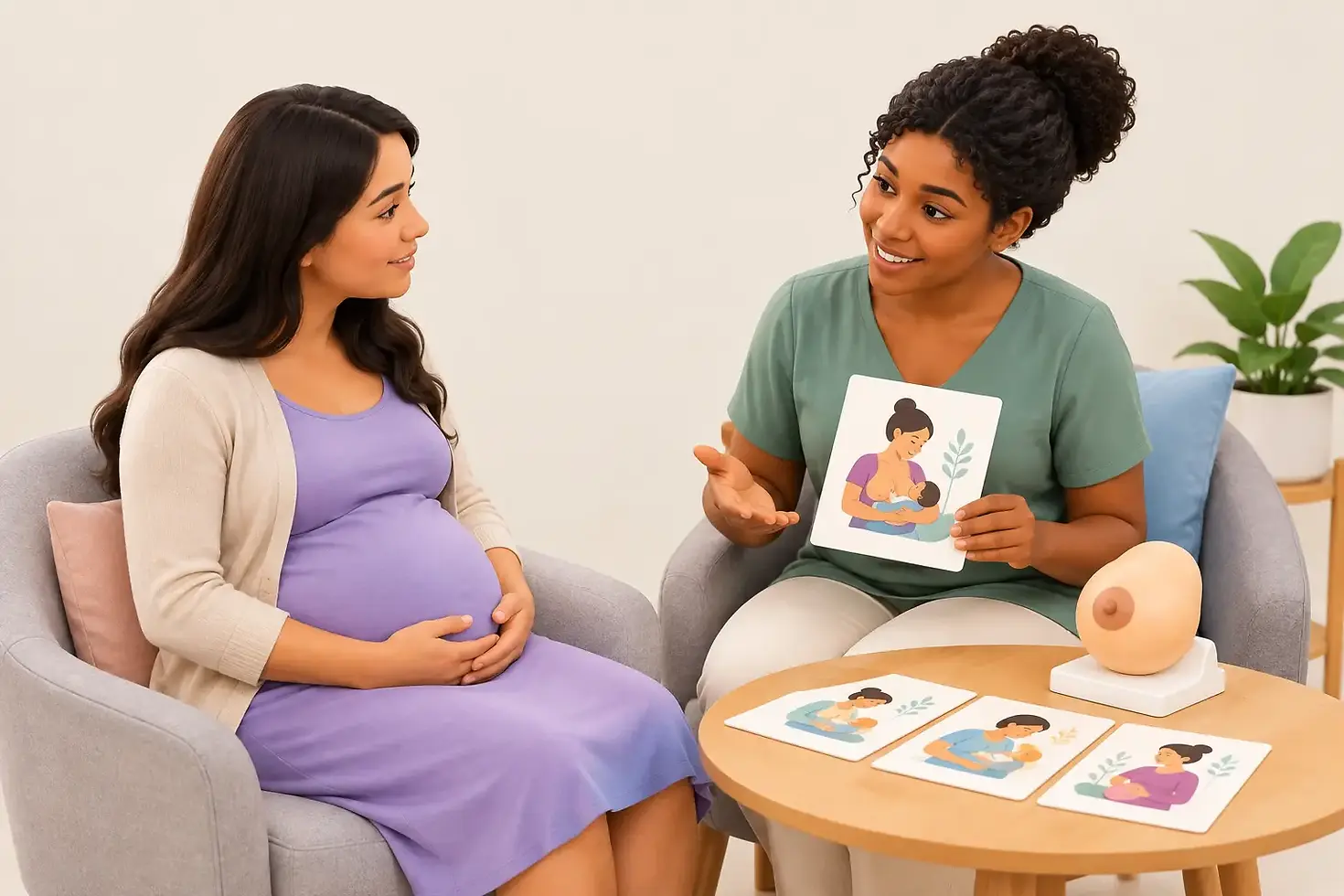
Antenatal Hand Expression

Colostrum can be collected before a baby is born, and for some families this can be a useful option to have available after birth. For others, antenatal hand expression may not be necessary or appropriate.
Collecting colostrum before birth is not a requirement for breastfeeding, and the amount collected during pregnancy does not tell you how much milk you will produce after your baby is born.
What is antenatal hand expression?
Antenatal hand expression is the process of expressing colostrum by hand during the final weeks of pregnancy and collecting it for use after your baby is born.
Colostrum is the first milk produced by the breasts. It is concentrated and contains nutrients, antibodies and other components that support your newborn during the first days of life (CUH, 2023).
Colostrum is produced from relatively early in pregnancy, but actively expressing it is generally discussed from around 36–37 weeks, depending on your individual circumstances and local maternity guidance (CUH, 2023).
The term "colostrum harvesting" is sometimes used to describe antenatal collection.
When might antenatal hand expression be considered?
Antenatal expression may be discussed where there is a reason to anticipate that a baby could benefit from having expressed colostrum available after birth.
This can include:
diabetes in pregnancy, where a baby may be more likely to experience low blood glucose after birth
a baby who is expected to need additional support with feeding
a baby who may need care on a neonatal unit
some situations where a baby's growth or health has been a concern during pregnancy
some multiple pregnancies
other circumstances identified by the maternity team.
The evidence for antenatal expression has mainly focused on pregnancies where there is a particular reason to anticipate a need for expressed colostrum, especially diabetes in pregnancy. In the DAME trial, women with diabetes in pregnancy who were at low risk of complications were advised to hand express twice daily from 36 weeks. The study found no evidence that this increased neonatal intensive care admission compared with standard care (Forster et al., 2017).
This does not mean that antenatal expression is necessary for everyone. Your maternity team can help you decide whether it is appropriate in your circumstances.
When antenatal hand expression is not advised
> Antenatal hand expression can stimulate the release of oxytocin, which can cause uterine contractions and may potentially trigger labour. If you have any circumstances that could increase concern about premature birth or other pregnancy complications, do not start antenatal hand expression without first discussing it with your maternity team.
This may include:
a history or increased risk of premature labour
a shortened cervix
a cervical stitch
vaginal bleeding during pregnancy
a low-lying placenta or placenta praevia
ruptured membranes or fluid loss
some multiple pregnancies
concerns about your baby's wellbeing
any other pregnancy complication where your maternity team has advised avoiding nipple stimulation.
The DAME trial found no evidence of harm from antenatal expression from 36 weeks in women with diabetes who were considered to be at low risk of complications (Forster et al., 2017). This does not mean that antenatal expression is appropriate in every pregnancy.
If you are expressing and experience regular or painful contractions, vaginal bleeding, fluid loss, reduced fetal movements or anything else that concerns you, stop expressing and contact your maternity team or maternity triage for advice.
When is antenatal expression usually started?
Many maternity services recommend starting around 36–37 weeks of pregnancy. The exact timing varies between services and depends on individual circumstances.
For example, the DAME trial began antenatal expression at 36 weeks in women with diabetes who were considered to be at low risk of complications (Forster et al., 2017).
Your own maternity team's advice should take priority over a general timeframe.
How do you hand express colostrum?
Antenatal colostrum is collected by hand rather than with a breast pump.
Before you start:
Wash your hands thoroughly.
Find somewhere comfortable and warm where you can relax.
Gentle breast massage or a warm shower or flannel may help you feel more comfortable and encourage milk release.
Have your sterile collection syringe or other equipment ready.
To hand express:
1. Place your thumb and finger in a C-shape around the breast, a little way back from the nipple.
2. Gently press your fingers back towards your chest, rather than squeezing the nipple.
3. Keeping your fingers in position, gently compress and release them rhythmically. Avoid sliding your fingers over the skin.
4. When the flow slows, move your fingers around the breast to express from a different area. You can then repeat the process on the other breast.
It can take a little while before colostrum appears. You may see tiny beads or drops initially, although the amount can vary considerably between women and between expressing sessions.
Hand expression should not be painful. If it is uncomfortable, stop and check your technique with your midwife or infant feeding team.
For more information about hand expression, see How to Express Breastmilk.
How much colostrum should you expect?
There is no set amount that you should be able to collect. Some women may initially see only a glisten of colostrum or collect less than 1 ml, while others may collect considerably more. Both can be normal.
The amount collected can also change from one expressing session to another. Not seeing much colostrum does not mean that you will not produce milk after your baby is born.
Colostrum is concentrated and newborn babies need relatively small amounts in the early days. This is why 1 ml syringes are commonly used for antenatal collection (CUH, 2023).
Colostrum catchers and syringes
Your maternity service may provide syringes or a colostrum catcher for collecting antenatally expressed colostrum. It is worth checking with your maternity team which equipment they recommend and whether there are any specific requirements for bringing your collected colostrum into hospital.
Some maternity services use syringes with a securely attached cap for collection and storage. You may also be asked to place your labelled syringes into a labelled freezer bag before freezing. The exact arrangements vary between maternity services, so check what your hospital asks you to use before you start collecting.
Your maternity service may provide its own syringes, labels and storage bags. If so, use the equipment supplied and follow their instructions rather than substituting different products.
Because local systems differ, also check whether your maternity service accepts antenatally collected colostrum brought into hospital and, if so, how they want it prepared for admission.
Labelling and storing antenatal colostrum
Your maternity service can tell you exactly how they want your colostrum labelled and stored.
Common requirements include labelling the individual syringe with details such as your name, date of birth or hospital number, together with the date and time of expression. Some services also ask for the volume collected, particularly where a label covers the syringe markings.
Some NHS services ask for the labelled syringes to be placed into a clean, sealed or resealable freezer bag, with the bag itself labelled with identifying details.
Others have different systems so its worth finding out in advance and follow the instructions provided by your chosen maternity service.
Taking frozen colostrum into hospital
Check with your maternity service before your baby is born about whether they want you to bring your frozen colostrum in when you are admitted.
This is particularly important because hospitals do not all have the same facilities for storing antenatally expressed colostrum.
Some maternity services ask families to bring only a small number of frozen syringes initially, with further syringes brought in if they are needed. This can reduce the chance of colostrum thawing before it is required.
Frozen colostrum should normally be transported in a cool bag with frozen ice packs and handed to the maternity staff on arrival so that they can advise you about local storage arrangements.
What happens when frozen colostrum is thawed?
Storage and thawing instructions vary slightly between maternity services.
Once frozen colostrum has been completely thawed, it should not be refrozen. The time it can be kept after thawing also depends on the local guidance. Some NHS services specify that it should be used within 24 hours, while others have much shorter time limits.
This is one reason why maternity services may recommend bringing only a small amount of frozen colostrum into hospital.
What happens to the colostrum after your baby is born?
How and when your antenatally expressed colostrum is used will depend on your baby's individual circumstances.
If your baby is feeding effectively and does not need additional milk, you may not need to use the colostrum you have collected antenatally.
If additional milk is indicated, your own expressed colostrum may be one of the options discussed with you. Your maternity team can advise you about how it can be given alongside responsive feeding and ongoing breast stimulation.
Having colostrum stored does not replace skin-to-skin contact, responsive feeding or support with positioning and attachment. It is simply something that may be useful to have available if it is needed.
You can read more about breastfeeding latch and positioning and increasing breast milk production in our other articles.
References
Association of Breastfeeding Mothers (n.d.) Hand expressing. Available at: https://abm.me.uk/breastfeeding-information/hand-expressing/
Cambridge University Hospitals NHS Foundation Trust (2023) Antenatal hand expression of breast milk guidance. Available at: https://www.cuh.nhs.uk/patient-information/antenatal-hand-expression-of-breast-milk-guidance/
East Lancashire Hospitals NHS Trust (n.d.) Antenatal hand expressing colostrum. Available at: https://elht.nhs.uk/services/maternity-and-newborn-services/infant-feeding/antenatal-hand-expressing-colostrum
Forster, D.A. et al. (2017) ‘Advising women with diabetes in pregnancy to express breast milk in late pregnancy (DAME): a multicentre, unblinded, randomised controlled trial’, The Lancet, 389(10085), pp. 2204–2213. Available at: https://pubmed.ncbi.nlm.nih.gov/28589894/
Foustanellas, A. et al. (2021) ‘Antenatal breast milk expression: a scoping review’, Women and Birth. Available at: https://pubmed.ncbi.nlm.nih.gov/33712049/
Hull University Teaching Hospitals NHS Trust (2024) Antenatal Colostrum Collection. Available at: https://www.hey.nhs.uk/patient-leaflet/33253/
Leeds Teaching Hospitals NHS Trust (n.d.) Antenatal hand expressing. Available at: https://www.leedsth.nhs.uk/patients/resources/antenatal-hand-expressing/
NHS England (2026) Neonatal choking hazard from colostrum syringe caps. Available at: https://www.england.nhs.uk/long-read/neonatal-choking-hazard-from-colostrum-syringe-caps/
Right Decisions (2024) Antenatal colostrum harvesting. Available at: https://rightdecisions.scot.nhs.uk/maternity-gynaecology-guidelines/maternity/antenatal-general/antenatal-colostrum-harvesting-1154/
Sobik, M. et al. (2023) ‘Education and experiences of antenatal breast milk expression: a systematic review’, Breastfeeding Medicine, 18(2), pp. 107–115. Available at: https://pubmed.ncbi.nlm.nih.gov/36724491/


Comments