


Breastfeeding latch and positioning

There is no single breastfeeding position that every caregiver and baby needs to use, and you may find you change the way you hold your baby throughout your feeding journey for all sorts of reasons. A position that felt comfortable when your baby was newborn may not feel quite so practical a few months later, while a position you initially struggled with may become your favourite once your baby is bigger and more confident at the breast.
You may have been shown a particular position in hospital or by a midwife or breastfeeding supporter, only to discover that it does not feel quite the same when you are sitting on your own sofa at 3am. That does not mean you are doing it wrong. Breastfeeding positions are not fixed techniques that have to be reproduced exactly. They are different ways of arranging your bodies so that your baby can come comfortably to the breast and you can sustain the feed.
The important thing is not whether your baby looks as though they are in a particular "correct" position. What matters is whether you are comfortable, your baby can attach well and feeding is working for you both.
Start with positioning before thinking about the latch
Positioning and attachment are closely connected, but they are not quite the same thing. Positioning is about how you arrange yourself and your baby in relation to the breast, while attachment describes how your baby takes the breast into their mouth.
A baby can appear to be in a good position but still attach shallowly or uncomfortably. Equally, changing the way you position your baby can sometimes make it much easier for them to achieve a deeper and more comfortable attachment.
Before thinking about exactly where your baby's mouth should go, it is worth considering your own position too. You need to be comfortable enough to remain there for the duration of the feed. Supporting your back, arms or feet can make a considerable difference, particularly during long or frequent feeds. The aim is not to hold your baby in a particular pose but to create an arrangement in which your baby can come close to the breast without you having to lean forwards, twist or hold their weight entirely with your arms.
For more about the principles of attachment and getting a deeper latch, see How to improve infant latch: practical breastfeeding support.
Your baby's whole body matters
It is easy to focus on the baby's mouth because that is where the latch happens, but the rest of the body matters too.
Your baby's chest and tummy will generally be facing towards you, with their body close enough to the breast that they do not have to stretch or twist to reach it. Their head, neck and body should be reasonably well aligned rather than their head being turned towards the breast while their body faces somewhere else.
A useful principle is to think about your baby's ear, shoulder and hip being in a straight line. This does not mean that your baby has to look rigid or perfectly symmetrical. Babies move, and different positions will naturally alter the angle of their body. The important point is that they are not twisted through the neck or body while trying to feed.
You may also come across the memory aid CHINS:
Close
Head free
In line
Nose to nipple
Sustainable
CHINS is a useful way of remembering the underlying principles, rather than a requirement for your baby to look exactly the same at every feed. Research into CHINS has also explored how families experience using it as a breastfeeding memory aid, with participants describing it as useful particularly during the early stages of breastfeeding (Shotton and Collins, 2024).
How your baby comes onto the breast
The way your baby approaches the breast is important. Rather than bringing your baby's face directly towards the nipple as though the nipple were a target, your baby's head can be allowed to tip back as their mouth opens.
Think about what happens when someone takes a large drink from a glass. They do not usually bring the glass directly towards the centre of their mouth while keeping their head completely still. As they take a larger drink, the head tilts back, the mouth opens and the drink enters the mouth from above.
The same principle can help explain what happens when a baby comes onto the breast. Your baby's nose is level with the nipple, but their head is angled upwards, as though they are looking or pointing upwards towards your forehead. This creates the angle needed for the mouth to open widely while the chin comes towards the breast.
As your baby's mouth opens, the lower jaw moves while the upper part of the skull remains relatively still. The breast itself is also not weightless. As the breast rests against the baby's chin, its weight can help the chin move downwards and encourage the lower jaw to take a greater mouthful of breast tissue.
This means that the lower part of the attachment can contain more breast tissue, rather than the baby simply taking the nipple into the centre of the mouth. The breast is effectively coming up and over into the open mouth, with more tissue being taken into the mouth on the underside of the latch.
In simple terms, think of it as nose to nipple, head angled upwards, mouth opens, chin leads and the breast goes up and over into the mouth.
This is different from trying to line the nipple up with the centre of your baby's mouth like a bulls-eye and bringing the baby's face directly forwards onto it. The aim is for your baby to take a larger mouthful of breast tissue rather than attaching primarily to the nipple.
Allowing the head to tip back also means you should avoid pushing the back of your baby's head forwards towards the breast. Your baby's head needs to be free enough to move as they open their mouth and attach.
An asymmetrical latch
A comfortable and effective attachment does not necessarily mean that the nipple sits in the exact centre of your baby's mouth.
With an asymmetrical attachment, the nipple enters the mouth at an angle and the baby takes more breast tissue into the lower part of the mouth. This fits with the wider principle of allowing the chin to lead and the baby to take a larger mouthful of breast rather than simply attaching to the nipple itself.
You may also notice that there is more of the darker nipple and areola skin visible above your baby's upper lip than below their lower lip. NHS guidance describes this as one of the signs that can be seen with effective attachment (NHS, 2026).
It is important not to turn this into another "perfect latch" test, though. Areolas vary considerably in size, shape, colour and symmetry. Someone with a very large areola will naturally have a different visual appearance from someone with a small one, and the amount of visible areola may also be affected by individual breast anatomy. The marker is therefore most useful when considered alongside how the feeding feels, how your baby is feeding and what the attachment actually looks and feels like.
The 'Flipple' technique

The 'flipple' technique is a way of changing the starting angle of the nipple so that it is directed upwards towards the roof of the baby's mouth rather than forwards into the centre of the mouth.
The term 'flipple' is used in breastfeeding support to describe this particular approach, but the named technique itself has limited specific research. The underlying principles are more established: starting with the baby's nose level with the nipple, allowing the head to tip back, waiting for a wide gape, bringing the chin to the breast first and allowing the nipple to enter the mouth towards the roof rather than aiming it straight forwards (NHS, 2026).
To use the technique, start with your baby's nose level with your nipple and their head angled upwards towards your forehead. Support your breast so that the nipple is angled upwards. As your baby opens their mouth wide and brings their chin towards the breast, release the finger or thumb that was supporting the upper surface of the breast while continuing to support underneath.
This allows the breast and nipple to move further into your baby's mouth. As the baby's mouth closes around the breast, their suction or vacuum can help draw the nipple further back towards the soft palate.
The "flip" is therefore not about putting the nipple into your baby's mouth like a target. It changes the starting angle and allows your baby's gape, chin-first approach and suction to bring the breast further into the mouth.
Breastfeeding should be comfortable
A position can look technically good and still not be comfortable for you. There is no benefit in maintaining a position simply because someone has told you that it is the "right" one if your shoulders are aching, your back is strained or your baby's attachment is painful.
This is one reason why the final part of CHINS is sustainable. A breastfeeding position needs to be something that you can actually maintain, particularly when feeds are frequent or long.
Some initial tenderness can occur when breastfeeding is being established, but persistent or significant pain deserves attention rather than simply being accepted as part of breastfeeding. Persistent nipple or breast pain can have a number of possible causes, and the Academy of Breastfeeding Medicine recommends assessing the feeding dyad when pain persists rather than assuming that one explanation applies to everyone (Berens et al., 2016).
For more about painful attachment, see Painful breastfeeding latch: support that helps.
What if you have larger breasts?
Breast size can influence which positions feel comfortable and how much support you need. This is not because there is a particular position that people with larger breasts are supposed to use, but because the breast itself may need more support while your baby comes to the breast.
Some caregivers find a sandwich hold helpful, where the breast is gently compressed to make it easier for the baby to take a larger mouthful. A scissor hold, using the fingers to support the breast, is another option that some people find useful.
Neither hold is compulsory. If your baby is attaching comfortably without you holding the breast, there is no reason to add another hand or another technique simply because you have been told you should.
The shape and size of the breast can also mean that you need to position your baby slightly differently on one side compared with the other. Breasts are not necessarily identical, and there is nothing unusual about finding that one side works better with a slightly different arrangement.
What about milk supply?
Positioning is only one part of breastfeeding and should not be treated as a complete explanation for milk supply.
Effective milk removal can influence milk production, so a comfortable attachment that allows your baby to transfer milk effectively can be relevant to supply. However, milk production and milk transfer are influenced by many factors, and concerns about supply need to be considered in the wider feeding picture rather than assuming that changing position will solve the problem.
UNICEF UK Baby Friendly guidance includes positioning, attachment, milk production and milk transfer as related but distinct parts of assessing breastfeeding (UNICEF UK Baby Friendly Initiative, 2013).
Different breastfeeding positions
There are many named breastfeeding positions, but you do not need to learn all of them. They are simply different ways of arranging your bodies, and some will suit you better at particular times than others.
The positions described below are examples rather than a list of positions that you need to learn. In fact, you can make up your own position if it is comfortable and effective for your feeding dyad. The names given to breastfeeding positions are useful for describing familiar arrangements, but babies and breasts do not always fit neatly into named categories.
As long as your baby is well supported, their ear, shoulder and hip remain appropriately aligned, their head and neck are free to move, and they can come onto the breast comfortably and feed effectively, there is plenty of scope to experiment. In essence, if a baby wanted to feed upside down and both of you could safely and comfortably maintain the position, there is no breastfeeding rule that says the position has to have a particular name.
The important principles are more useful than the label.
Cradle hold
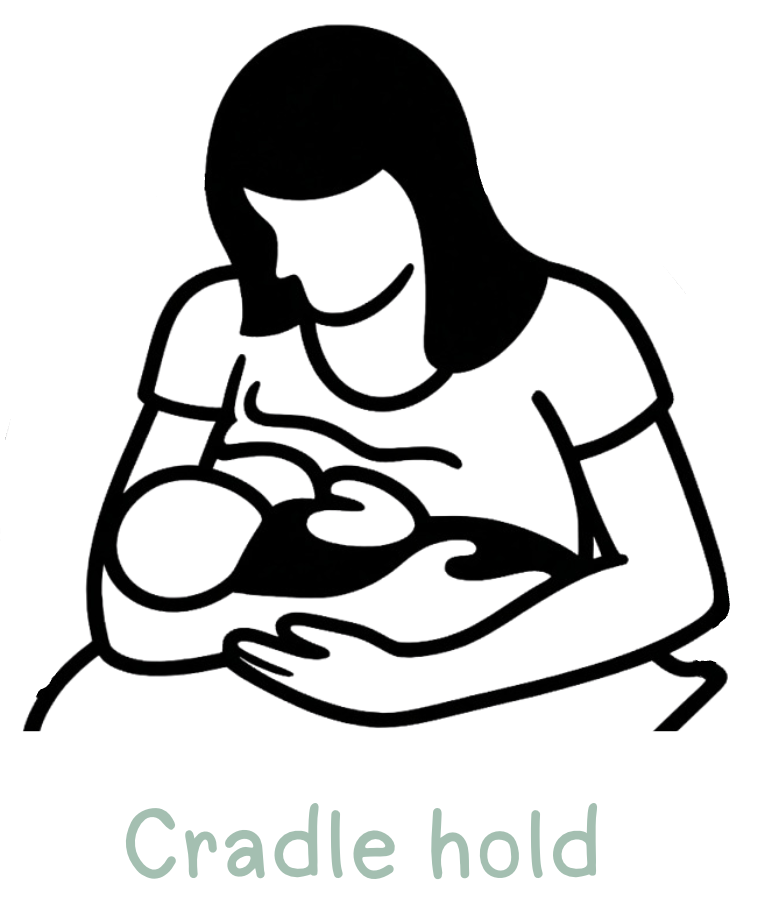
The cradle hold is one of the positions many people recognise immediately. Your baby's body lies across your lap, with their head supported by the arm on the same side as the breast they are feeding from.
It can be comfortable once you and your baby are confident with breastfeeding, particularly when your baby has good head and body control. However, it is not necessarily the easiest position for a newborn who is still learning to attach because it can be harder to control the baby's approach to the breast.
Supporting your own arms and back can make a big difference. You should not need to lean forwards to keep your baby's mouth at the breast.
Cross-cradle hold

In the cross-cradle position, your baby lies across your body as in the cradle hold, but you use the opposite arm to support and guide your baby's body.
This gives you more control over your baby's position and can be particularly useful while you are learning what helps your baby attach comfortably. It can also make it easier to see what your baby's mouth is doing as they come onto the breast.
Once your baby is well attached, you may find that you can gradually relax your hold rather than continuing to actively control the feed.
Rugby or football hold

In the rugby or football position, your baby is tucked alongside your body rather than lying across the front of your tummy. Their legs point behind you and their head is positioned near the breast.
Some people find this particularly useful after a caesarean birth because the baby's body does not need to rest across the abdomen. It can also be useful if you have larger breasts, if you want a different angle on the breast or when feeding twins.
The NHS includes the rugby hold among its commonly used breastfeeding positions (NHS, 2026).
Laid-back or reclined breastfeeding

Laid-back breastfeeding is different from simply sitting slightly backwards while your baby lies beside you. In a true laid-back position, you are comfortably reclined and your baby is really lying against you, with their body supported on your body rather than simply being placed on their side next to you.
Your baby's tummy can rest against your tummy or chest, with their body supported by yours. This can allow your baby to make use of their own movements and can be particularly useful when you want to give them more freedom to approach the breast.
Research into laid-back breastfeeding has found associations with reduced nipple pain and trauma and improved positioning and attachment compared with some traditional positions, although the evidence has limitations and further research is needed (Wang et al., 2021).
If you are very tired or there is any possibility that you may fall asleep, however, breastfeeding and sleeping are separate considerations. Sofas and armchairs are particularly unsafe places to fall asleep with a baby. The Lullaby Trust provides specific safer-sleep guidance for situations where feeding occurs in bed and for avoiding accidental sleep on sofas or chairs (The Lullaby Trust, 2026).
Side-lying

Side-lying can be particularly useful for night-time feeds or when sitting upright is uncomfortable. You and your baby lie facing one another, with your baby close enough to reach the breast without needing to twist their neck.
The ear, shoulder and hip alignment remains useful here too. Your baby should not need to turn their head sharply towards the breast while their body faces the other direction.
Side-lying can be comfortable for feeding, but it is important to distinguish feeding from sleep. If there is any chance you may fall asleep, consider the safer-sleep guidance for bed sharing and make sure you understand when bed sharing is not recommended. Never intentionally fall asleep with a baby on a sofa or armchair (The Lullaby Trust, 2026).
Koala / Saddle position

In a koala or saddle hold position, your baby is sitting more upright against your body rather than lying horizontally across your lap.
This can work particularly well as babies become more capable of sitting with support and may suit babies who dislike being held horizontally for every feed. It can also be useful when a baby wants to remain more upright between or during feeds.
There is no need to wait for a particular age before experimenting with a more upright position, provided your baby is properly supported and can feed comfortably.
The seatbelt position

The seatbelt position is a variation in which the baby sits more upright across your body, with their body and legs extending towards the opposite side, rather like a seatbelt crossing your torso.
It can provide a useful alternative for an older baby who is becoming more mobile and no longer wants to remain in a traditional cradle position.
As babies become stronger and more curious, you may find that the named positions become less useful than simply finding a stable arrangement that allows them to reach the breast comfortably.
Dancer hold
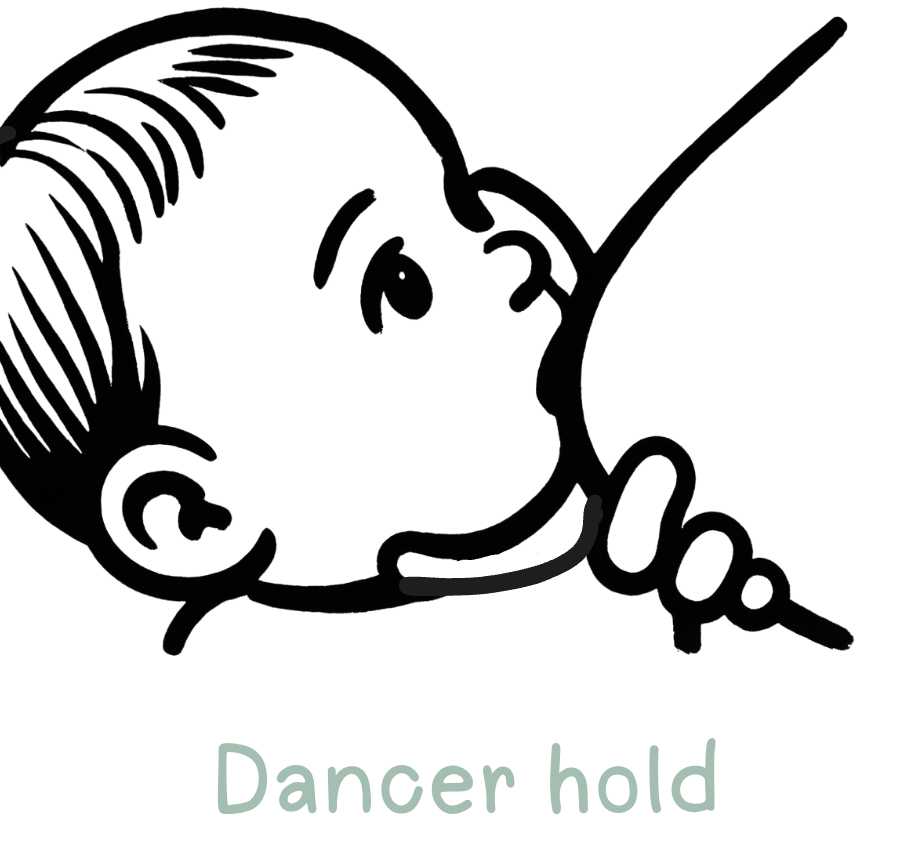
The dancer hold is a breastfeeding technique that provides additional support beneath a baby’s jaw while they feed. The baby is positioned facing the breast, with their body supported under the caregiver’s arm in a semi-reclined or football/rugby-style position, although the technique can be adapted to other breastfeeding positions. The caregiver supports the breast with one hand while using the thumb and fingers of the same hand to form a gentle U-shape beneath the baby’s cheeks and jaw. This can be particularly helpful for babies with low muscle tone, a less stable jaw, or difficulty maintaining a deep latch, as the additional support can help them maintain their position and sustain their latch during the feed.
Older babies
Breastfeeding positions often become much less formal as babies grow.
A baby who once needed to be carefully supported across your lap may eventually climb onto you, kneel beside you, sit across your thigh or feed while you are both lying down. Older babies may also move around considerably during a feed, particularly if they are distracted or interested in what is happening around them.
This does not necessarily mean that the attachment is poor. Development changes the way babies use their bodies, and the position that worked for a newborn may simply no longer be necessary.
Twins and higher-order multiples

With twins or higher-order multiples, feeding at the same time can be practical for some families, but it is not essential. Many babies in a multiple birth do not want to feed at the same time, particularly as they grow and develop their own feeding patterns. Feeding each baby separately is perfectly possible, and families can use a mixture of simultaneous and individual feeds depending on what works for them.
The rugby or football position is often used when feeding twins simultaneously because it allows one baby to be positioned on each side of the body, but other combinations are possible too. The NHS specifically notes that trying different breastfeeding positions can help families find what suits them best when feeding twins or multiples (NHS, 2026).
Changing position during a feed
There is no reason to remain in one position for an entire feed if another position becomes more comfortable or seems to work better as the feed progresses. Your baby may change their own position as they become more relaxed, as milk flow changes or as the breast becomes softer, and you may find that your own body needs a different level of support after sitting in the same position for a while.
Some feeding dyads naturally move between positions during a feed, while others find one position that remains comfortable from beginning to end. You may even find that one breast feels easier in one position and the other breast in another. As babies grow, their preferences can change too, so the position that worked when your baby was two weeks old may not be the position they choose at six months.
Breastfeeding does not need to look the same every time, and there is nothing wrong with changing position simply because you and your baby prefer something different.
If, however, you find yourself repeatedly changing positions because your baby cannot maintain the latch, feeding remains painful, your baby is struggling to transfer milk or feeds are becoming increasingly difficult, that is different from simply experimenting with positions. At that point, rather than continuing to try one position after another, it would be appropriate to have the feeding observed and evaluated by someone suitably qualified to assess breastfeeding and infant feeding.
When changing position does not solve the problem
Positioning can make a substantial difference, but it cannot explain or resolve every breastfeeding difficulty. If your baby repeatedly slips from the breast, you are experiencing persistent pain or nipple damage, feeds are exhausting, or there are concerns about milk transfer, milk production or your baby's growth, the feeding picture needs to be considered more broadly.
A skilled feeding assessment should look at what is actually happening during the feed rather than simply matching a symptom to a particular position or anatomical finding. This may include your baby's attachment and milk transfer, your comfort, breast or nipple factors, milk production and flow, your baby's health and development, oral function and the interaction between all of these factors.
This is where having a feed observed by someone appropriately qualified can be much more useful than being given another list of positions to try. The aim is to understand why feeding is difficult for this particular dyad and whether a change in position is actually likely to help.
Persistent pain, repeated loss of attachment or concerns about feeding effectiveness therefore deserve a proper breastfeeding evaluation rather than an expectation that you should simply keep experimenting until you find the "right" position.
The position that works is the one that works for you
There is no prize for making breastfeeding look like the picture in a leaflet.
The best position for you may change from feed to feed, breast to breast, day to day and as your baby grows. You may use a traditional cradle hold one day, feed lying down the next, discover that your baby prefers to feed upright for a while, or end up inventing something that does not have a name at all.
The useful principles are simple: you and your baby need to be comfortable, your baby needs to be close and well supported, their body should be appropriately aligned, their head should be free to move and they should be able to open their mouth and come onto the breast comfortably.
Breastfeeding positions are there to give you options, not rules. The position that works is the one that allows you and your baby to feed comfortably, effectively and sustainably.
References
Berens, P., Eglash, A., Malloy, M. and Steube, A.M. (2016) ‘ABM Clinical Protocol #26: Persistent pain with breastfeeding’, Breastfeeding Medicine, 11(2), pp. 46–53. doi:10.1089/bfm.2016.29002.pjb.
NHS (2026) ‘Breastfeeding: positioning and attachment’. Available at: https://www.nhs.uk/baby/breastfeeding-and-bottle-feeding/breastfeeding/positioning-and-attachment/
NHS (2026) ‘Breastfeeding positions’. Available at: https://www.nhs.uk/best-start-in-life/baby/feeding-your-baby/breastfeeding/how-to-breastfeed/breastfeeding-positions/
NHS (2026) ‘Feeding twins and multiples’. Available at: https://www.nhs.uk/baby/newborn-twins-and-multiples/feeding-twins-and-multiples/
Shotton, L. and Collins, T. (2024) ‘Breastfeeding mothers’ awareness and experience of using the breastfeeding memory aide CHINS: an exploratory descriptive qualitative study’, Reproductive, Female and Child Health, 3, e108. doi:10.1002/rfc2.108.
The Lullaby Trust (2026) ‘Co-sleeping’. Available at: https://www.lullabytrust.org.uk/baby-safety/safer-sleep-information/co-sleeping/
UNICEF UK Baby Friendly Initiative (2013) ‘The evidence and rationale for the UNICEF UK Baby Friendly Initiative standards’. London: UNICEF UK.
UNICEF UK Baby Friendly Initiative (2020) ‘Supporting effective breastfeeding: CHIN principles’. London: UNICEF UK Baby Friendly Initiative.
Wang, Z., Liu, Q., Min, L. and Mao, X. (2021) ‘The effectiveness of the laid-back position on lactation-related nipple problems and comfort: a meta-analysis’, BMC Pregnancy and Childbirth, 21, 248. doi:10.1186/s12884-021-03714-8.


Comments